
Step 1: Verification Package
Chapter 1 Summary
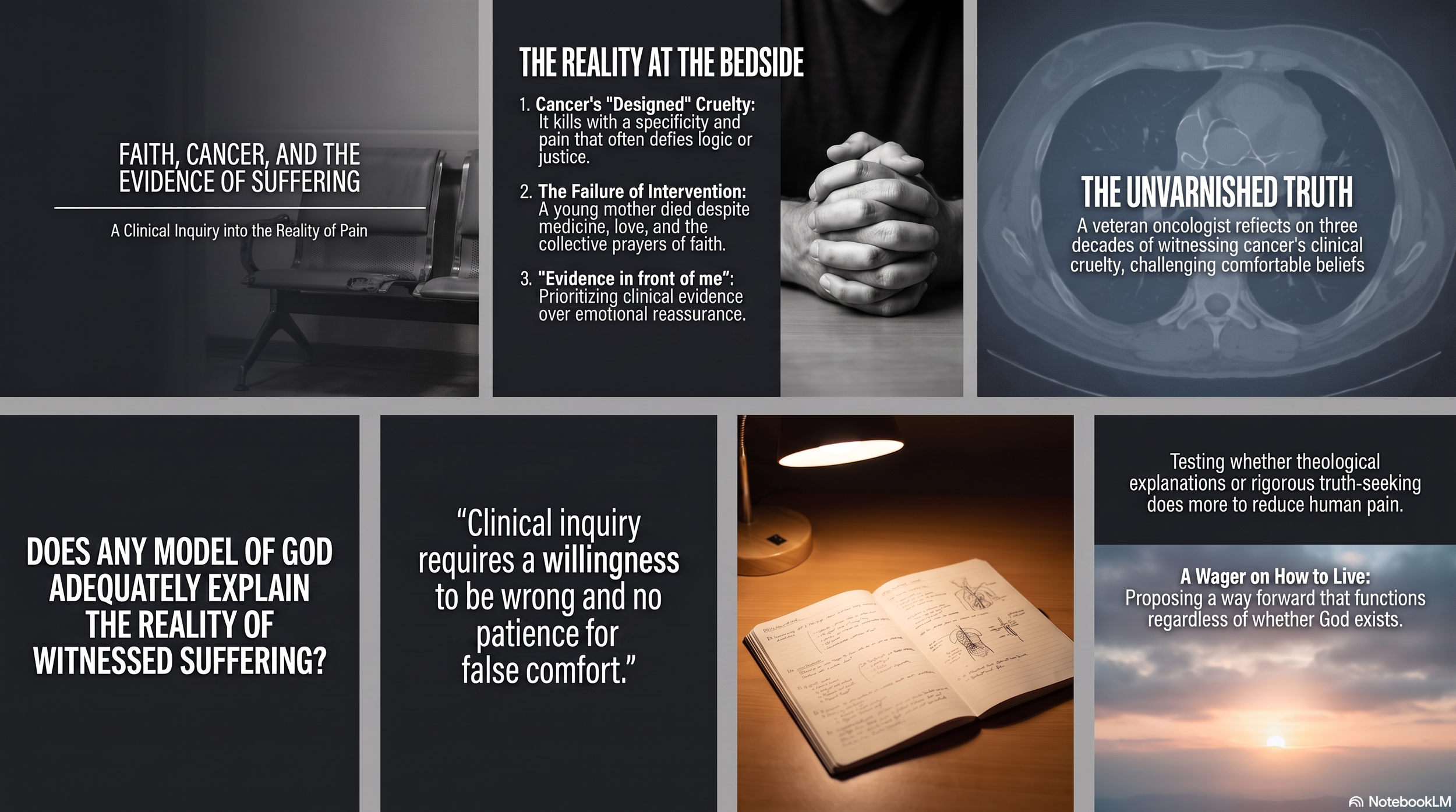
In Chapter 1, retired gynecologic oncologist J. Namaste. M.D. introduces his book by shifting the focus of the human suffering debate away from abstract theological theories and straight to the clinical reality of the bedside. Grounding his inquiry in the tragic death of a twenty-eight-year-old mother who died of terminal cancer despite fervent prayers, he intentionally narrows his scope to "authorless" suffering—disease and biological decay that no human hand chose or caused.
Dr. Namaste explicitly states he is not debating whether God exists. Instead, he poses a direct, two-part target question: Does any model of God we actually believe in adequately explain this bedside agony, and if none do, how must we face and reduce human suffering? He introduces a systematic plan to test six traditional models of God directly against the unvarnished facts of cancer biology.
Step 2: Response Section
Step 2: Christian Response Framework
Strategic Alignment: Where the Framework Meets Clinical Reality
The historic Christian framework meets Dr. Namaste on the exact same ground of clinical reality: the visceral horror of the bedside. Like Dr. Namaste, who rejects "answers that comfort without being true", the Christian framework—articulated by D.A. Carson, R.C. Sproul, and John MacArthur—violently rejects glib, sentimental theology.
At the bedside of a 28-year-old mother dying of cancer, the Christian framework agrees that "ignorant Christian triumphalism" (which demands immediate healing) and secular arrogance both fail the sufferer. Furthermore, the Christian model fiercely rejects "rescue operations" like Open Theism or Process Theology, which attempt to absolve God by claiming He lacks the power or knowledge to stop the tumor. As Sproul notes, a God who is merely a grieving, helpless spectator whose "hands are tied" offers no real comfort to the dying.
Strategic Divergence: Where the Road Forks
The road forks precisely on the nature of God's absolute sovereignty and the origin of biological decay. Where a clinician might see a random, unjust, and "authorless" cellular mutation, the Christian framework defines this through the cellular reality of the Fall. Dr. Martyn Lloyd-Jones, utilizing his medical background, argues that biological decay is "creation's wound," meaning disease is not a natural design but a theological consequence of a fallen cosmos.
Furthermore, regarding the sovereignty of God, MacArthur and Carson insist on "compatibilism": God is intimately and absolutely sovereign over every cell, tumor, and biological law. He did not passively watch the cancer develop; He sovereignly willed and ordained for it to exist without being the moral author of evil. God governs the "second causes" of biological decay, meaning that even the most harrowing natural suffering falls entirely within His ultimate, purposeful control.
Response to Target Question 1: Does any model of God we actually believe in adequately explain the suffering witnessed at the bedside?
Yes, but it does so by elevating God’s eternal purposes over human demands for immediate fairness. The Christian model asserts that God does not owe humanity a life free of pain, but rather uses the tragedy of the bedside for ultimate, redemptive glory.
The Problem of "Why": When confronting the "incoherent" nature of a young mother's death, God does not provide a neat, formulaic answer. As seen in the Book of Job, when interrogated by suffering, God does not explain the specific biological mechanics or reasons for the pain; He answers the sufferer with Himself. The wisdom of God lies in trusting His character when the specific "why" remains hidden.
The Display of Glory: MacArthur argues that God intentionally designed a world where evil exists to put His own attributes on everlasting display. Without the terrifying backdrop of "authorless" natural evil and deep pain, humanity would never comprehend the staggering depths of God's grace, mercy, love, and comfort.
Suffering as a Vocation: Sproul posits that for the believer, suffering is never an "exercise in futility" or a meaningless accident. God may actually call an individual to suffer as a divine vocation—a harrowing assignment used to refine character, demonstrate faith to the world, and serve a holy purpose we cannot yet see.
Response to Target Question 2: If none of them does, what does that mean for how we face suffering, and how we reduce it?
Because the biblical model does explain suffering through the lens of sovereign providence, it radically alters how practitioners and patients face the bedside and work to reduce pain.
Facing Suffering through the Solidary Love of the Cross: We do not face suffering with stoicism or denial, but by looking to John Stott's perspective of the "suffering God". The ultimate Christian answer to the 28-year-old mother's bedside is the Cross of Christ. Stott argues that a God immune to pain would be impossible to worship in our broken world. Instead, God laid aside His immunity, entering the physical, excruciating agony of flesh and blood to stand in absolute solidarity with the broken. The Cross proves that while God allows suffering, He does not exempt Himself from it; He is the "Man of sorrows" who majors in suffering and redeems the world through it. (John MacArthur, The Man of Sorrows)
Reducing Suffering through Concurrence: The Christian framework fully supports the aggressive reduction of physical pain. Lloyd-Jones teaches the doctrine of "concurrence," wherein God cooperates with and works through the natural properties of medicine and the skills of the physician. The oncologist is an instrument of God's common grace.
Preventative Medicine and Pastoral Presence: Carson argues that we face suffering by applying theological "preventative medicine" before the crisis hits, building firm structures of belief so patients are not "knocked silly" when cancer arrives. Yet, when the crisis is active, the Christian response shifts from intellectual debate to incarnational presence. As Sproul and Stott model, facing suffering often means simply sitting in the sorrow, weeping with the family, and being the silent, respectful presence of Christ to a neighbor whose pain defies logic.
Ultimately, the historic framework asserts that the bedside is not the end. The Christian faces cancer with the "hope of final glory", knowing that the God who ordained the suffering also ordained the resurrection, where the wasted body will be raised immune to disease, pain, and death forever.