
The Dialogue Platform
Welcome to the dialogue sandbox, an interactive research platform designed to evaluate the intersection of terminal cancer biology and biblical theodicy. These pages operate on a structured, two-part methodology to ensure complete intellectual honesty:
Step 1: The Verification Package (Top): Dedicated exclusively to verifying that we have accurately understood and summarized the precise clinical lens, questions, and baseline evidence presented in Dr. Namaste's opening manuscript chapters.
Step 2: The Scholarly Response Framework (Bottom): A staged, comprehensive synthesis presenting the historic Christian framework in direct dialogue with the clinical reality of the bedside.
Examine the evidence, engage the media modules, and join the conversation.
Step 1: The Verification Package
The Difference Between Chapter 3 and Chapter 4
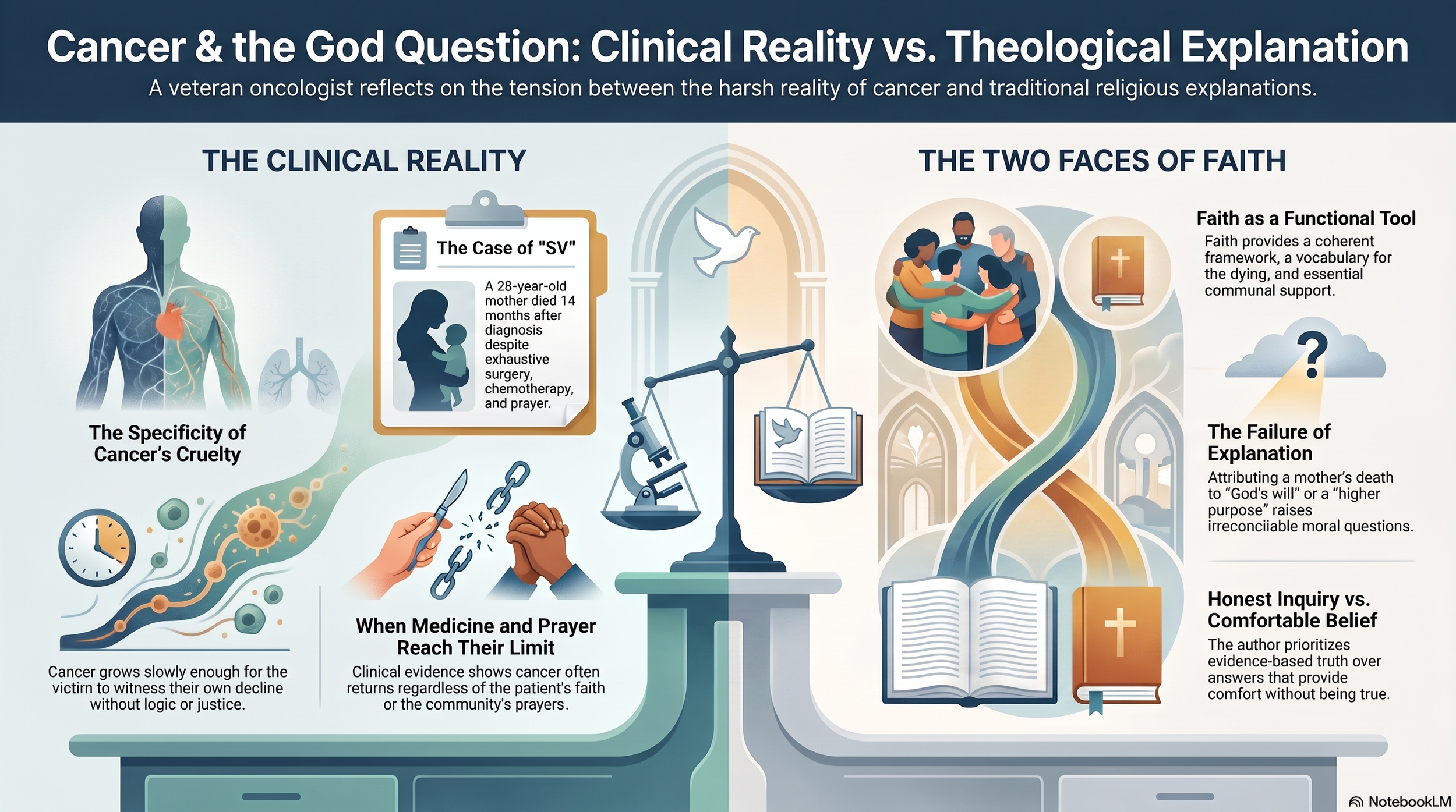
In these introductory chapters, Dr. J. Namaste is showing that the traditional religious view of the world doesn't work.
Chapter 3: What Suffering Asks (Clearing the Field)
In Chapter 3, Dr. Namaste acts like a building inspector looking at the traditional explanations Christians use to explain why people get sick. He takes the three most common ideas—that suffering is a punishment for doing bad things, a warning message from God, or a test to build your character—and holds them up against a real-world cancer ward.
His Conclusion: These ideas fall apart instantly under real-world pressure. A young mother dying of an aggressive tumor didn't do anything to "deserve" it, the disease doesn't act like a rational message, and it doesn't stop just because a person has "learned their lesson." Joe leaves the reader in an empty space where traditional religious comfort feels completely broken.
Chapter 4: The Alarm That Will Not Stop (Filling the Space)
Instead of leaving that space empty, Dr. Namast immediately steps into it with Chapter 4. He stops talking about theology and switches entirely to evolutionary biology.
His Argument: Pain isn't a supernatural curse or a spiritual test; it is just a basic, biological alarm system. Think about a caveman touching a hot ember: the nerve signal makes him pull his hand back instantly. Living things that felt pain survived long enough to have kids and pass on their genes; things that didn't feel pain got injured and died out. To prove it, he points to kids born with a rare genetic condition where they feel no physical pain at all—they end up accidentally destroying their own bodies because they lack this vital biological alarm.
His Finale: If pain is just an alarm system built by blind evolutionary survival, then "there is no God listening on the other end of the line. There is no divine plan. Because God isn't running the system, the job of helping the person screaming in pain falls 100% onto human shoulders.
Step 2: The Scholarly Christian Response Framework
A staged, intellectually rigorous counter-synthesis to the problem of clinical suffering.
🎙️ Module A: The 19-Minute Deep-Dive Briefing
Asset: Terminal Cancer and the Sovereign God
Focus: A dynamic, high-stakes academic dialogue holding Dr. Namaste's clinical lens in intense, localized tension with historic Reformed theology.
Core Thesis: This audio briefing pushes past basic summaries to tackle the agonizing mechanics of the bedside. The hosts dissect the "rogue surgeon" liability trap, contrast the dignified but ultimate finality of a secular death against the cosmic enemy of biblical decay, and explore the ancient Near Eastern imagery of the "sea" in Revelation as the permanent, physical unmaking of cancer's chaotic metastasis.
🎬 Module B: The 6-Minute Explainer Video
Asset: The Explainer: The Bedside Dialectic
Focus: An unblinking narrative tracking the tragic baseline of SV's 14-month clinical decline against the structural reality of biblical theodicy.
Core Thesis: Both honest medicine and historic theology share an absolute outrage over glib "retribution math" that turns God into an abusive human tactician. Rather than offering an itemized philosophical receipt for a tumor, the orthodox tradition asserts a hidden sovereignty—a profound character to trust and a divine presence that anchors the crushing weight of terminal illness when clinical protocols run completely dry.
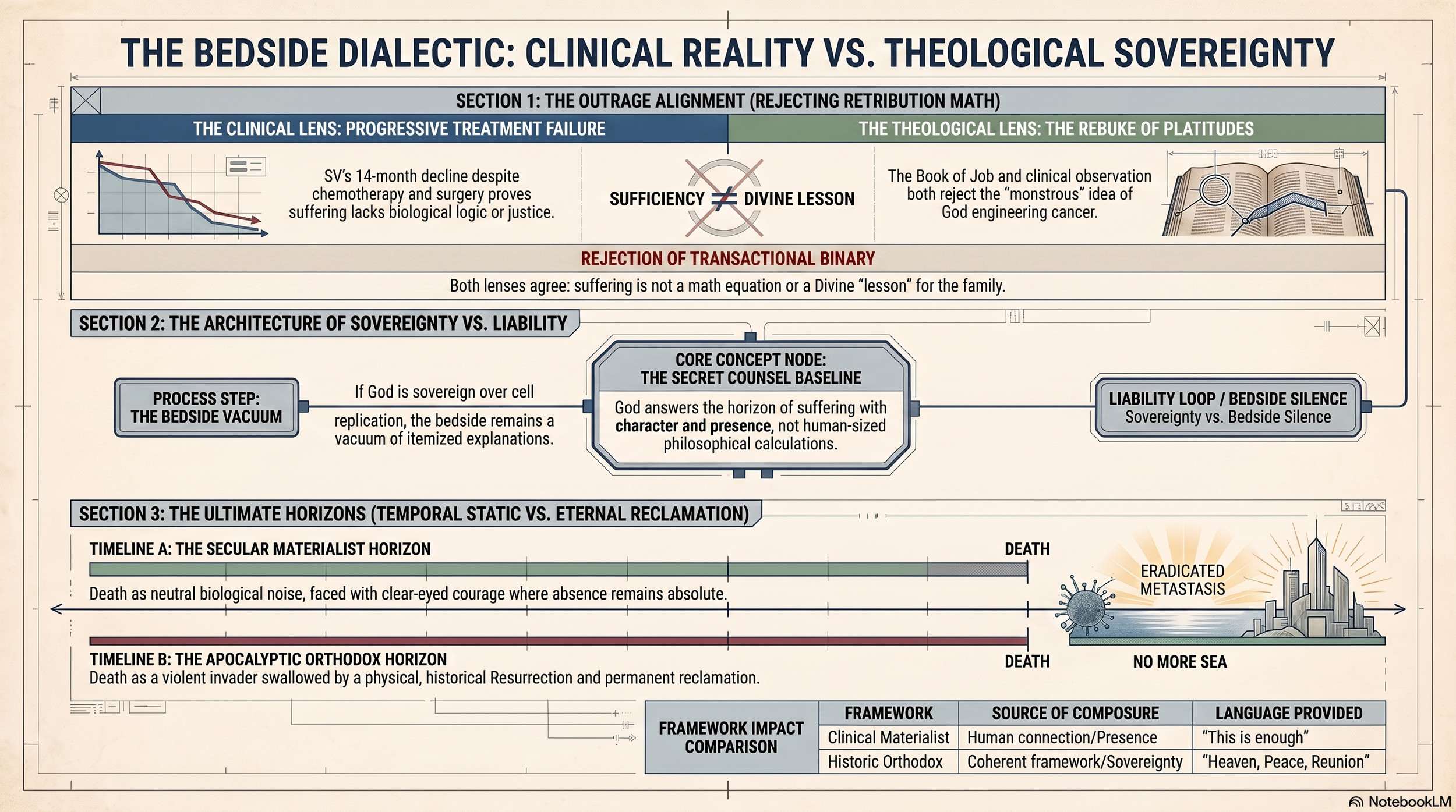
📊 Module C: The Dialogue Architecture Infographic
Asset: The Bedside Dialectic Matrix
Focus: A high-contrast, dual-axis visual blueprint mapping the logical intersection of clinical oncology and Reformed theodicy.
Key Elements Featured:
The Outrage Alignment: A direct side-by-side mapping demonstrating why both clinical data and biblical theology flatly reject the "monstrous" transactional idea of God engineering cancer.
Sovereignty vs. Liability: A flow chart tracking the tension of ultimate divine control operating alongside a clinical vacuum of itemized explanations.
Framework Impact Comparison: A final analytical matrix evaluating the structural source of composure and specific existential language ("This is enough" vs. "Heaven, Peace, Reunion") across secular materialist and historic orthodox horizons.
Ask the Experts (click to access)
Query Seed for the Medicine/Theology Wing: "Dr. Namaste claims that an unyielding demand for empirical evidence leaves the God question entirely unanswered at the bedside of SV. Based on the historical legacy of Dr. Martyn Lloyd-Jones and Blaise Pascal, how does a Counter-Theodicy answer a mind trapped in this specific existential lockdown?"
Query Seed for the Mathematical Defense Wing: * "Dr. Namaste deduces from the raw tragedy of cancer biology that the universe is an accidental, materialist closed-loop. How do Dr. Sergiu Klainerman’s insights on the mathematical lawfulness of deep reality challenge the secular horizon without minimizing the clinical reality of SV’s decline?"
Query Seed for the Apologetics Wing: * "When Dr. Namaste attacks the hollow, transactional platitudes offered by religious people in the face of 'authorless' suffering, how does the Respondent use Timothy Keller and C.S. Lewis to show that historic orthodox Christianity actually agrees with the doctor's clinical outrage?"